Zero-Knowledge Proofs: Ethereum’s Scalability and Privacy Superpower?
Ethereum, the world’s leading smart contract platform, faces ongoing challenges related to scalability and privacy. As network activity increases, transaction fees rise and processing speeds slow down. Moreover, transactions are inherently transparent, potentially exposing sensitive information. Zero-Knowledge Proofs (ZKPs) are emerging as a powerful solution to address these limitations, offering the potential to significantly improve Ethereum’s performance and protect user privacy.
Introduction: The Ethereum Scalability & Privacy Challenge (and How ZKPs Can Help)
Ethereum’s popularity brings both advantages and disadvantages. The increased demand for block space leads to higher gas fees, making simple transactions expensive. This limits accessibility, especially for smaller transactions and users in developing economies. Furthermore, every transaction is publicly recorded on the blockchain, which, while ensuring transparency, compromises privacy. Anyone can track transaction histories and potentially link addresses to real-world identities.
ZKPs offer a compelling alternative. They allow one party (the prover) to convince another party (the verifier) that a statement is true, without revealing any information beyond the validity of the statement itself. This has profound implications for both scaling and privacy:
- Scalability: By using ZKPs to verify batches of transactions off-chain, we can significantly reduce the load on the Ethereum mainnet.
- Privacy: ZKPs enable private transactions where the details are hidden from the public, while still ensuring the validity of the transaction.
What are Zero-Knowledge Proofs (ZKPs) and How Do They Work?
Imagine you have a magic box with a colored ball inside. You want to prove to someone that you know the color of the ball without revealing what the color actually is. That’s the basic idea behind a ZKP.
More formally, a ZKP must satisfy three properties:
- Completeness: If the statement is true, an honest prover can convince an honest verifier.
- Soundness: If the statement is false, a cheating prover cannot convince an honest verifier.
- Zero-Knowledge: The verifier learns nothing beyond the fact that the statement is true.
There are several types of ZKPs, including:
- zk-SNARKs (Zero-Knowledge Succinct Non-Interactive ARguments of Knowledge): Known for their small proof sizes and fast verification times. They require a trusted setup, which involves generating cryptographic parameters that must be kept secret.
- zk-STARKs (Zero-Knowledge Scalable Transparent ARguments of Knowledge): Offer greater transparency as they don’t require a trusted setup. They generally produce larger proofs than zk-SNARKs but are more scalable.
The process generally involves encoding the statement to be proven into a circuit. Let’s illustrate a simplified concept with Python. While actual ZKP implementations are much more complex, this shows how computation can be represented:
def prove_sum(a, b, sum_val):
  """
  Simplified example - actual ZKP is far more complex.
  This just demonstrates a calculation we might want to prove.
  """
  if a + b == sum_val:
    return True  # "Proof" passes
  else:
    return False # "Proof" fails

# Example Usage (in reality, 'a', 'b', 'sum_val' might be hidden)
a = 5
b = 3
sum_val = 8

proof_valid = prove_sum(a, b, sum_val)

if proof_valid:
  print("Proof is valid")
else:
  print("Proof is invalid")
This Python code is a very basic illustration. Actual ZKP systems involve sophisticated cryptographic techniques to create a proof without revealing ‘a’, ‘b’, and ‘sum_val’ directly. The verifier would only see a proof that the sum is correct, without knowing the individual values.
ZK-Rollups: Scaling Ethereum Transactions with ZKPs
ZK-Rollups are a Layer-2 scaling solution that leverages ZKPs to bundle multiple transactions into a single proof. This proof is then submitted to the Ethereum mainnet, drastically reducing the gas cost per transaction. Here’s how it works:
- Users submit transactions to the ZK-Rollup operator.
- The operator batches these transactions together.
- The operator generates a ZKP that proves all the transactions in the batch are valid according to the rollup’s rules.
- The operator submits this proof and the compressed transaction data to the Ethereum mainnet.
The mainnet only needs to verify the single ZKP, significantly reducing the computational load compared to verifying each transaction individually. This results in increased throughput and lower fees.
Examples of ZK-Rollup projects include:
- zkSync: Aims to provide scalable and low-cost payments on Ethereum.
- StarkNet: A decentralized, permissionless ZK-Rollup developed by StarkWare.
- Polygon Hermez: Another ZK-Rollup solution focused on optimizing transaction costs.
Privacy on Ethereum: Shielding Transactions with ZKPs
Beyond scaling, ZKPs can also enhance privacy on Ethereum. They enable users to perform transactions without revealing the sender, receiver, or transaction amount.
Here’s how it generally works:
- Hidden Inputs: The sender and receiver addresses, as well as the transaction amount, are kept secret using cryptographic commitments.
- Zero-Knowledge Proof: A ZKP is generated to prove that the transaction is valid (e.g., the sender has sufficient funds), without revealing the hidden inputs.
- On-Chain Verification: The ZKP is verified on the Ethereum mainnet, ensuring the transaction’s integrity without disclosing any sensitive information.
Projects like Aztec Network are utilizing ZKPs to build privacy-focused DeFi solutions on Ethereum, enabling users to trade, lend, and borrow assets privately.
Challenges and the Future of ZKPs on Ethereum
Despite their immense potential, ZKPs still face certain challenges:
- Computational Complexity: Generating ZKPs can be computationally intensive, requiring specialized hardware and expertise.
- Trusted Setup (for zk-SNARKs): The trusted setup phase for zk-SNARKs poses a security risk if the secret parameters are compromised. Newer technologies like zk-STARKs address this issue.
- Development Complexity: Building ZKP-based applications requires specialized knowledge and tooling, making development more challenging.
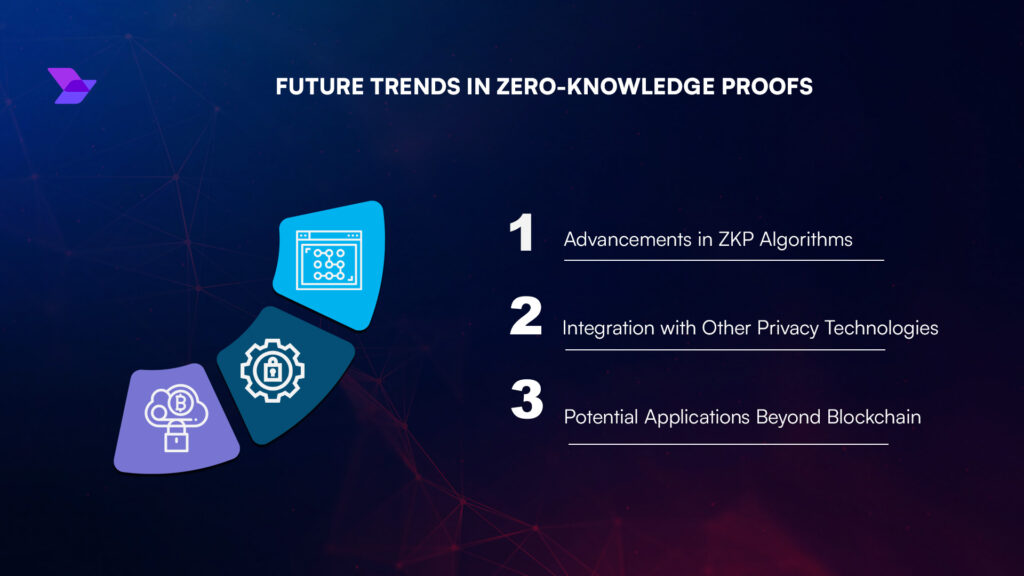
However, advancements in cryptography, hardware acceleration, and developer tools are rapidly addressing these challenges. As the technology matures, we can expect to see wider adoption of ZKPs on Ethereum.
When deploying these advanced ZKP-powered applications, you’ll need a reliable and fast hosting solution. I’ve found Hostinger to be an excellent choice. Their competitive pricing and ease of use make it a great option, especially for developers who need a cost-effective platform for testing and deploying their solutions. Their speed is impressive, which is critical for applications that demand high performance.
Conclusion: ZKPs – A Vital Piece of the Ethereum Puzzle
Zero-Knowledge Proofs are poised to play a critical role in the future of Ethereum. By offering solutions to both scalability and privacy challenges, ZKPs pave the way for a more efficient, accessible, and user-friendly blockchain ecosystem. While challenges remain, the rapid advancements in the field suggest that ZKPs will become an increasingly important technology for Ethereum and the broader blockchain space. The integration of ZKPs will unlock new possibilities for decentralized applications, enabling confidential transactions, scalable DeFi platforms, and secure on-chain governance. As the Ethereum ecosystem continues to evolve, ZKPs are undoubtedly a key piece of the puzzle.
Disclaimer: This is not financial advice.
Visual Guide
A[Ethereum] –> B(Scalability Issues);
A –> C(Privacy Issues);
B –> D{High Gas Fees};
B –> E{Slow Transaction Speeds};
C –> F{Transaction Transparency};
C –> G{Privacy Concerns};
H[Zero-Knowledge Proofs (ZKPs)] –> I{Solution};
I –> B;
I –> C;
I –> J[Prover];
I –> K[Verifier];
J –> L{Prove Statement is True};
K –> M{Verify Statement without Knowing Details};
I –> N(Off-Chain Verification);
N –> O(Reduced Mainnet Load);
I –> P(Private Transactions);
P –> Q(Hidden Transaction Details);